
Tove Jansson
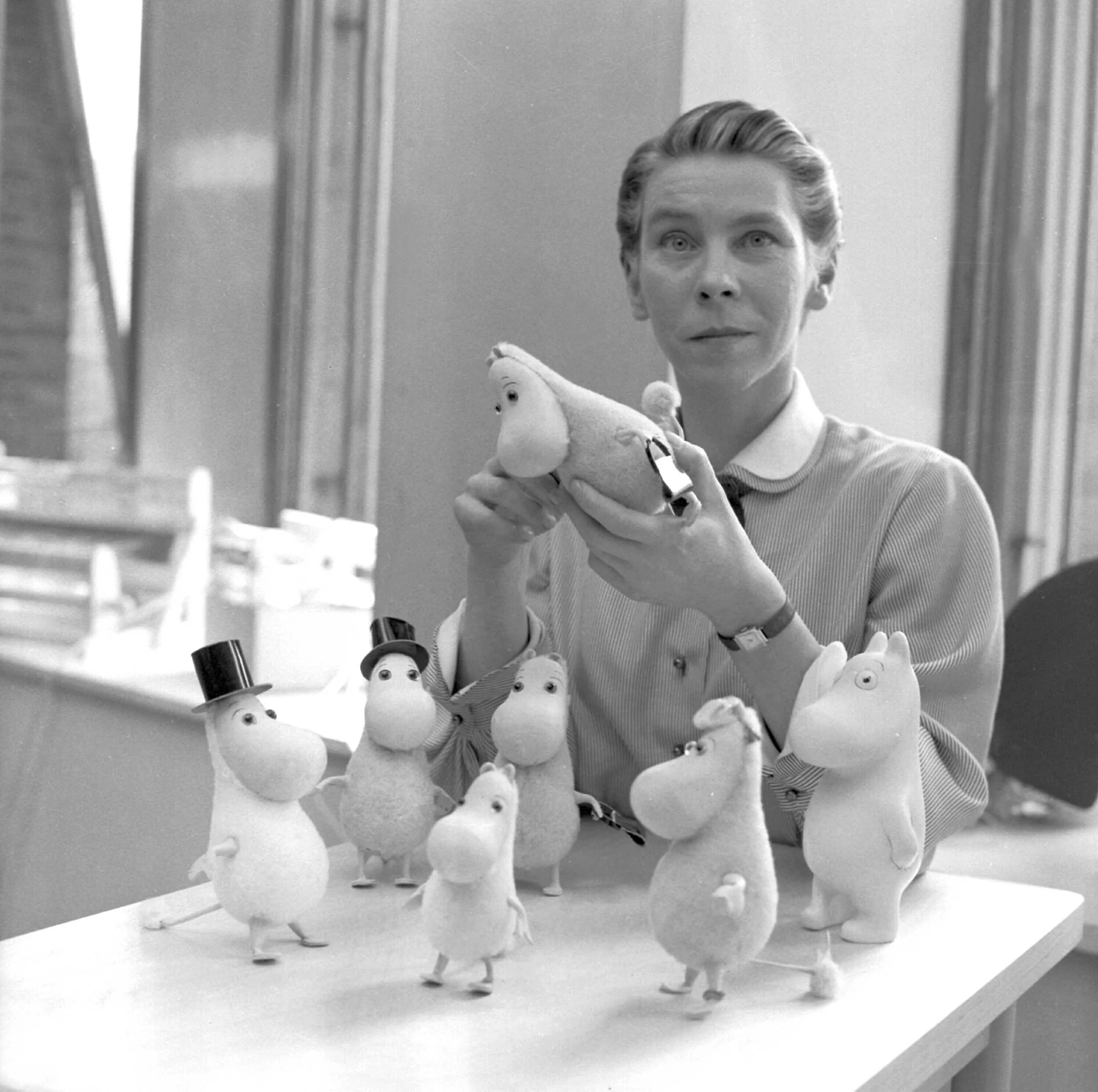
Image from Wikipedia
Image from Wikipedia
Tove Jansson: The great storyteller behind the Moomins and a rarely deep art
An artist who merged images, language, and atmosphere into a world
Tove Jansson is considered one of the most extraordinary voices of Nordic culture in the 20th century. As a Finnish-Swedish writer, illustrator, comic author, graphic artist, and painter, she created a body of work that extends far beyond the famous Moomin trolls. Her life journey began in 1914 in Helsinki and led to an international career that uniquely combined literature, visual art, and popular culture.
From an early age, family, art, and a dual cultural identity shaped her thinking. The daughter of two artists grew up in an environment where design, observation, and discipline were natural. From this background, Jansson developed an artistic language that maintains a distinctive balance of warmth, irony, melancholy, and imagination.
Early years: Originating from an artist household in Helsinki
Tove Jansson was born on August 9, 1914, in Helsinki. Her parents Viktor Jansson and Signe Hammarsten Jansson were both artistically inclined, and this environment shaped her worldview from childhood. As a member of the Swedish-speaking minority in Finland, she navigated a cultural in-between that significantly influenced her work.
Even as a teenager, her illustrations appeared in magazines. At the age of 14, she wrote her first book, which was later published under a pseudonym. This early productivity shows how naturally she connected images and text. Jansson never thought in narrow genre boundaries, but rather in scenes, moods, and narrative arcs.
Education and artistic formation
Jansson studied painting in Stockholm and evolved into a serious visual artist in the ensuing years. Her work was not limited to literature but grew from a strong foundation in the fine arts. Her early exhibition activity and work as an illustrator testify to a career that was remarkably versatile even before the global success of the Moomins.
Official biographical sources describe her life's work as spanning the entire 20th century. Her artistic development was not linear but a continual expansion: painting, book illustration, satire, comics, short prose, novels, and stage work flowed together in her endeavors. It is precisely this aspect that lends her authority as an artist.
The breakthrough with the Moomins: Fantasy as a response to war and reality
During World War II, Jansson increasingly turned to fantasy. This period produced the first Moomin book in 1945, Småtrollen och den stora översvämningen (The Moomins and the Great Flood). The Moomin world became her most significant contribution to world literature, evolving from both a personal and historical exceptional situation.
The success of the Moomins was based not only on child-friendly character design but also on a remarkably layered narrative style. Jansson combined adventure, philosophical questions, humor, and existential uncertainty. This mix made her books accessible to children and enduringly appealing to adults. Her world is open, yet never banal; friendly, but never harmless.
Comic strip, international distribution, and media versatility
Another milestone was the Moomin comic strip, which began in 1954 for a British newspaper and was later distributed worldwide. With this, Jansson reached a mass audience and simultaneously proved that her characters could also thrive in serialized form. The comic work required condensation, rhythm, and precise timing—qualities that further sharpened her drawing style.
The official biography also notes her work on theater, radio, and television content, as well as her role as a lyricist. Even as a painter, she remained active, creating stage designs, short stories, and novels. Jansson was not an author of a single success but an artist with a wide range of expression, continually reshaping her themes.
The literary work beyond the Moomins
Those who read Tove Jansson only as the creator of the Moomins overlook the scope of her oeuvre. In addition to children's books, she also wrote for adults, including the much-acclaimed novel The Summer Book from 1972. This book showcases her quiet, precise prose that intertwines nature observation, dialogue artistry, and psychological nuance.
Her picture books also represent some of the strongest works of her later period. Official sources mention, among others, Who Will Comfort Toffle?, The Dangerous Journey, and Who Was It?. Here, an author who masters reduction creates great emotional tension from seemingly simple forms is revealed. Her language remains concise, vivid, and atmospherically rich.
Style, composition, and artistic signature
In painting, Jansson was shaped by the figurative tradition and developed a clear visual language where light, color, and space play a central role. Her art combines narrative precision with painterly breadth. Nature, sea, islands, faces, and quiet places frequently emerge—motifs that unite her work.
What is particularly striking is her handling of contrasts. Her art thrives on the tension between humor and darkness, warmth and distance, childlikeness and seriousness. This duality imbues her books and images with timeless power. Jansson not only composed stories; she arranged moods.
Places of creation: Helsinki, the archipelago, and Klovharun Island
Helsinki remained the starting point of her life, but the archipelago landscape became a second spiritual center. Official sources emphasize that the sea was a leitmotif of her work, with Pellinge serving as an important summer and work location. Later, she lived and worked with Tuulikki Pietilä on Klovharun, an island that remains closely connected to her work.
These places are not merely backdrops in her art; they are resonant spaces. Jansson transformed landscape into atmosphere and everyday observation into poetry. In her books, one senses that she understood spaces not decoratively but existentially. This understanding is a significant part of her artistic originality.
Critical reception, cultural influence, and lasting impact
Tove Jansson received numerous awards and gained international recognition. Britannica describes her work as particularly popular in Europe and translated into over 50 languages. The Moomin stories have been adapted into films, television series, and other formats, and today they belong to the cultural memory far beyond Finland.
Her work also remains highly present in museum and curatorial contexts. Major exhibitions were held and are ongoing in Finland and internationally in 2024 and 2025, including presentations at the Moomin Museum and the Helsinki Art Museum. This shows that Jansson is not merely a classic author; she is an artist whose work continues to be read, exhibited, and discussed anew.
Current relevance: Why Tove Jansson fascinates today
Although Tove Jansson passed away in 2001, her cultural presence continues to grow. New exhibitions, digital archiving efforts, and ongoing adaptations keep her characters and themes alive. Her work resonates with contemporary readers because it addresses freedom, solitude, family, belonging, and imagination with great clarity.
This very openness makes her world feel so modern. Jansson writes not didactically, but observationally; not loudly, but precisely. Those who discover her books, pictures, and comics encounter an artist with an extraordinary stage presence in the printed medium—an author who shapes inner spaces as compellingly as visible landscapes.
Conclusion: A century artist with undiminished radiance
Tove Jansson remains captivating because she made fantasy a form of understanding rather than an escape. Her work connects literary depth, visual imagination, and human warmth at the highest level. The Moomins are merely the most well-known access point to a much larger artistic world.
Anyone reading or viewing Tove Jansson today discovers an author of rare independence. Her books and images invite engagement with tranquility, complexity, and subtle irony. A look into her work is always worthwhile—and on the stage of cultural history, she remains one of the great names.
Official channels from Tove Jansson:
- Instagram: No official profile found
- Facebook: No official profile found
- YouTube: No official profile found
- Spotify: No official profile found
- TikTok: No official profile found
Sources:
- Tove Jansson - Author and artist who created the Moomins - Official Website
- Tove Jansson - Biography - Official Website
- Tove Jansson - Tovepedia - Official Website
- Tove Jansson - Timeline - Official Website
- Britannica - Tove Jansson
- Moomin Museum - An exhibition about Tove Jansson opens in the Moomin Museum on 20 April 2024
- HAM Helsinki Art Museum - Tove Jansson – Paradiset
- HAM Helsinki Art Museum - Tove Jansson Gallery: Artist Family Jansson
- Wikipedia: Image and text source
Upcoming Events
Tove Jansson - The Summer Book Duisburg 2026
The Summer Book
Tove Jansson: The Summer Book
The Summer Book
The Summer Book
The Summer Book