
SWR Symphonieorchester
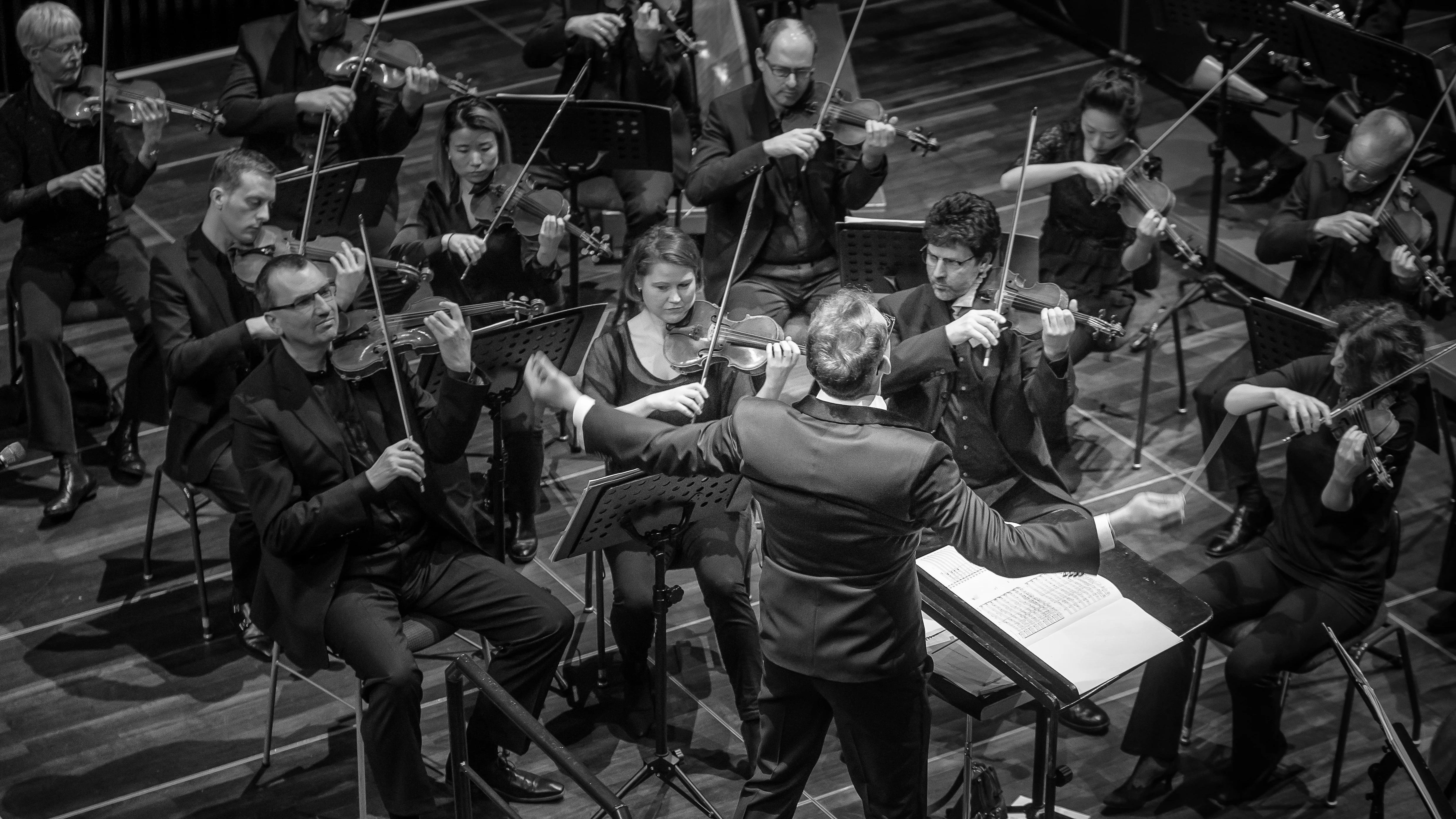
Image from Wikipedia
Image from Wikipedia
SWR Symphony Orchestra: Power of Sound between Tradition, Present, and Musical Future
An orchestra with character, stance, and a rich concert culture
The SWR Symphony Orchestra represents symphonic excellence from the southwest of Germany. Since the merging of the SWR Radio Symphony Orchestra Stuttgart and the SWR Symphony Orchestra Baden-Baden and Freiburg in September 2016, the ensemble combines two significant lines of tradition in one orchestra based in Stuttgart. Its artistic identity merges historically informed performance practice, the classical-romantic core repertoire, and contemporary music into a program that expresses both repertoire preservation and curiosity for new sound worlds. ([swr.de](https://www.swr.de/swrkultur/musik-klassik/symphonieorchester/article-swr-152.html))
The inception: A fusion with cultural depth
The establishment of the SWR Symphony Orchestra was more than an administrative merger. The fusion in September 2016 created an ensemble that brings together the artistic experiences of two renowned predecessor orchestras of SWR, thereby developing an extraordinary stylistic range. The two artistic homes in the Liederhalle Stuttgart and the Konzerthaus Freiburg anchor the orchestra regionally, while concert series in Stuttgart, Freiburg, and Mannheim, as well as festival appearances, expand its reach far beyond the southwest. ([swr.de](https://www.swr.de/swrkultur/musik-klassik/symphonieorchester/article-swr-152.html))
This dual anchorage shapes the music career of the orchestra: It acts simultaneously as a radio orchestra, concert orchestra, and cultural ambassador. The work on compositions from the classical to the avant-garde, the presence at the Donaueschingen Music Days, and the Schwetzingen SWR Festival, along with its residency at the Pfingstfestspiele Baden-Baden, clearly illustrate how consciously the ensemble shapes its role between tradition and the present. ([swr.de](https://www.swr.de/swrkultur/musik-klassik/symphonieorchester/article-swr-152.html))
Artistic development and conductor personalities
The SWR Symphony Orchestra has been and continues to be shaped by outstanding conductors who have significantly influenced its artistic development. In recent years, Teodor Currentzis has been at the helm of the orchestra; from September 2025, François-Xavier Roth will take over as chief conductor and artistic director. The SWR profiles thus emphasize a programmatic continuity at a high level: ambitious interpretations, precise sound culture, and a repertoire understanding that places historical and contemporary readings on equal footing. ([swr.de](https://www.swr.de/swrkultur/musik-klassik/symphonieorchester/article-swr-152.html))
Among the guest conductors are internationally sought-after names such as Herbert Blomstedt, Christoph Eschenbach, Pablo Heras-Casado, Manfred Honeck, Jakub Hrůša, Kent Nagano, Jonathan Nott, Andrés Orozco-Estrada, Eva Ollikainen, Michael Sanderling, and Giedrė Šlekytė. This collaboration showcases an orchestra that has arrived at the forefront of European symphonic music while remaining stylistically open. A significant part of its authority lies in this: artistic sovereignty combined with interpretative flexibility. ([swr.de](https://www.swr.de/swrkultur/musik-klassik/symphonieorchester/article-swr-152.html))
Repertoire, stage, and musical signature
The programming of the SWR Symphony Orchestra features a strikingly wide spectrum. In addition to the classical and romantic core repertoire, contemporary music plays a central role, as do works from the realm of historically informed performance practice. This combination gives the ensemble a clear profile: it does not view symphonic music as a museum tradition but as a living archive of European sonic history that is continuously reinterpreted. ([swr.de](https://www.swr.de/swrkultur/musik-klassik/symphonieorchester/article-swr-152.html))
The concert practice impressively underscores this. Concert recordings from the Stuttgart Liederhalle document programs with Bruckner, Strauss, Sibelius, Beethoven, Busoni, Mahler, Lutosławski, Saariaho, Debussy, Haydn, Shostakovich, Rachmaninoff, and Kapustin. This breadth showcases an orchestra that does not shy away from musical contrasts but rather makes them productive: from monumental late Romanticism to rhythmically sharply contoured modernism. ([swr.de](https://www.swr.de/swrkultur/musik-klassik/symphonieorchester/index.html))
Current projects and publications
In the 2024/25 and 2025/26 seasons, the SWR Symphony Orchestra remains productive and visible. Current projects include a masterclass for orchestral composition in cooperation with the Hochschule für Musik und Darstellende Kunst Stuttgart, enabling young composers to work with a professional symphony orchestra. Such formats demonstrate that the ensemble not only performs but actively engages in promoting musical talent and developing repertoire. ([swr.de](https://www.swr.de/swrkultur/musik-klassik/symphonieorchester/meisterkurs-orchesterkomposition-2026-100.html?utm_source=openai))
On the publications side, SWR points to new CD productions featuring works by Nikola Kapustin, a recording with the SWR New Talent Martin Lionel under the direction of Giedrė Šlekytė, and a recording under Ingo Metzmacher featuring rarely performed works by Igor Stravinsky. Additionally, there is a reference to the SWR labels and their CD and download offerings, positioning the orchestra as a documented sound body. ([swr.de](https://www.swr.de/swrkultur/musik-klassik/symphonieorchester/index.html))
Discography and critical reception
The SWR Symphony Orchestra does not have a classical discography in the sense of a pop or jazz catalog; its releases are project-based, often in collaboration with soloists and conductors. This is where the quality of this orchestra's discography lies: it documents stylistic versatility, repertoire awareness, and a willingness to permanently capture even extraordinary programs. The recordings highlighted by SWR Kultur featuring Kapustin, Kabalevsky, Shostakovich, Tchaikovsky, and Stravinsky clearly illustrate this ambition. ([swr.de](https://www.swr.de/swrkultur/musik-klassik/symphonieorchester/index.html))
The critical reception also categorizes the ensemble as a sound body of special weight. The MIZ describes the orchestra as a radio orchestra and symphony orchestra in the public context; SWR, in turn, emphasizes that concert recordings and streams enable many music lovers worldwide to access the performances. In this connection of live presence, media reach, and artistic quality lies a central cultural influence of the orchestra. ([miz.org](https://miz.org/en/institutions/swr-symphonieorchester-i32150?position=426&rows=1000))
Cultural influence and public duty
The SWR Symphony Orchestra fulfills not only an artistic but also an educational and cultural political mandate. According to SWR, its extensive music education program reaches around 20,000 children, young people, and adults annually in the broadcasting area. This positions the orchestra as an actor that promotes musical participation and does not treat classical music as an elitist domain, but as an open cultural practice. ([swr.de](https://www.swr.de/swrkultur/musik-klassik/symphonieorchester/article-swr-152.html?utm_source=openai))
Additionally, its strong presence in the festival and concert circuit is noteworthy. Performances at the Musikfest Berlin, in the Konzerthaus Dortmund, at the Elbphilharmonie Hamburg, in London, Barcelona, Madrid, Vienna, or Warsaw showcase an ensemble that is regionally rooted and internationally connected. This movement between home and world defines the cultural value of the orchestra: it conveys German orchestral tradition with contemporary openness. ([swr.de](https://www.swr.de/swrkultur/musik-klassik/symphonieorchester/article-swr-152.html))
For music lovers, the SWR Symphony Orchestra thus possesses a special allure. Experiencing this ensemble live means not only hearing flawless ensemble culture but also encountering a sound body that derives its identity from repertoire competence, contemporary curiosity, and musical precision. The orchestra stands for concerts with intellectual ambition and emotional force – a compelling reason to not only hear a performance but to experience it in the hall. ([swr.de](https://www.swr.de/swrkultur/musik-klassik/symphonieorchester/article-swr-152.html))
Conclusion: An orchestra that keeps the present and tradition in motion
The SWR Symphony Orchestra is an outstanding German ensemble because it does not merely preserve tradition but thinks further. Its biography is characterized by fusion, artistic density, and programmatic openness; its present by ambitious projects, important conductors, and a clear cultural mission. Those seeking orchestral art at a high level will find here an ensemble with character, depth, and a sense of the present. ([swr.de](https://www.swr.de/swrkultur/musik-klassik/symphonieorchester/article-swr-152.html))
This makes attending a concert particularly exciting: the interplay of discipline, energy, stylistic breadth, and audible joy in playing. The SWR Symphony Orchestra remains a must for anyone wishing to experience symphonic music as a living art form. ([swr.de](https://www.swr.de/swrkultur/musik-klassik/symphonieorchester/index.html?utm_source=openai))
Official channels of SWR Symphony Orchestra:
- Instagram: no official profile found
- Facebook: https://www.facebook.com/SWRSymphonie
- YouTube: https://www.youtube.com/channel/UC3Om1vqaHrJA-36haVSn7yQ
- Spotify: no official profile found
- TikTok: no official profile found
Sources:
Upcoming Events
Chamber Concert with Members of the SWR Symphony Orchestra
SWR Symphony Orchestra with Minasi: Wagner, Bartók, Dvořák
Chamber Concert with Members of the SWR Symphony Orchestra: Violin and Accordion