
Ei Arakawa-Nash
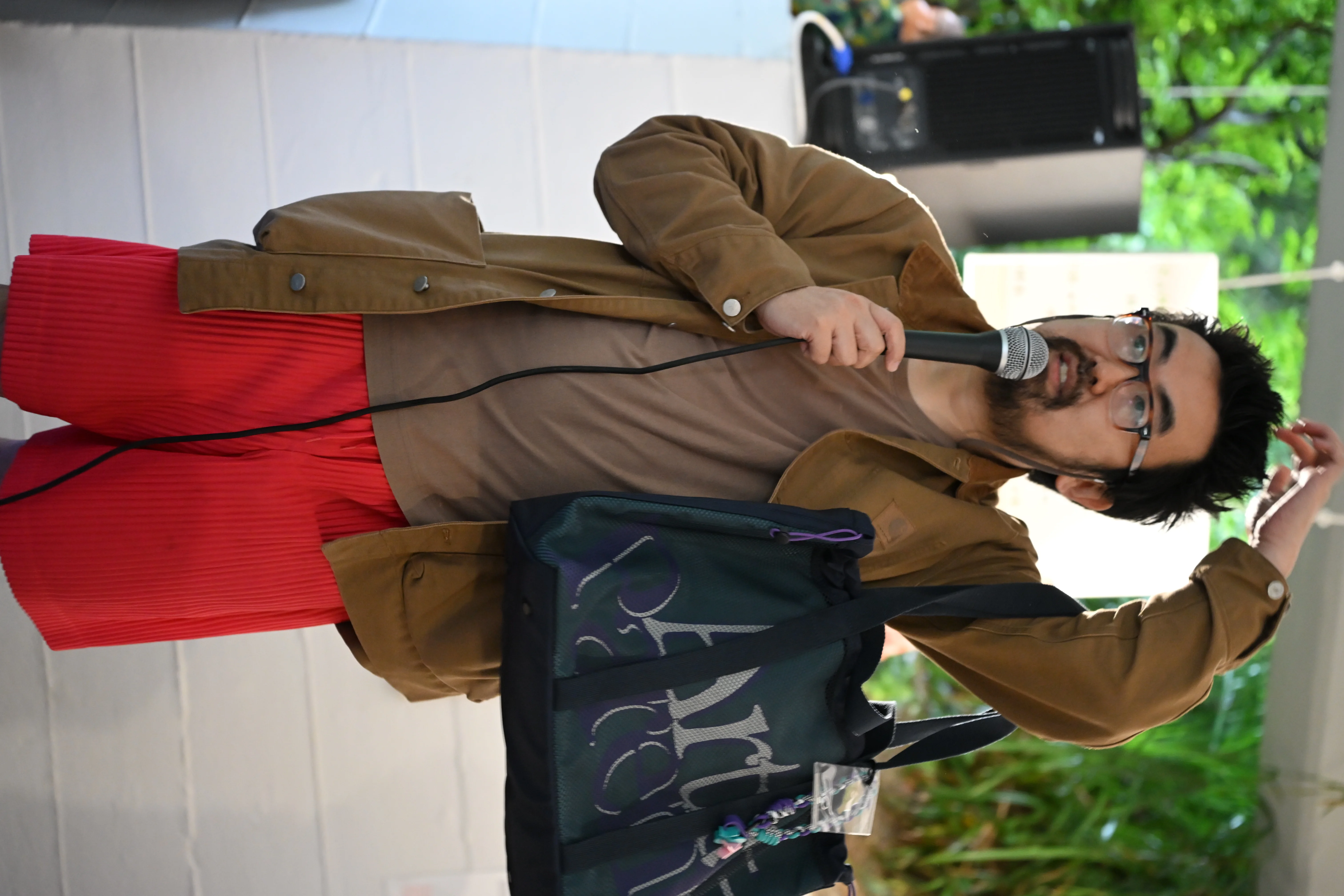
Image from Wikipedia
Image from Wikipedia
Ei Arakawa-Nash: Performance as Living Visual Art Between Collaboration, Improvisation, and the Present
An Artist Who Sets Space, Audience, and Ideas in Motion
Ei Arakawa-Nash is one of the most exciting voices in contemporary international art because he does not treat his work in performance, installation, and action art as separate disciplines, but as a vibrant total event. Born in 1977 in Iwaki, Fukushima Prefecture, the Japanese-American artist lives in New York City, Berlin, and for several years in Los Angeles; his artistic biography is closely linked to transnational experiences, institutional recognition, and a radically open stage presence. ([de.wikipedia.org](https://de.wikipedia.org/wiki/Ei_Arakawa-Nash))
What makes his music career in the broader sense of performative art so distinctive is the energy of the unfinished: Arakawa-Nash does not work with completed images, but with situations where body, painting, language, humor, and collective action intertwine. His works shift the status of actor, audience, and object and open art to improvisation, participation, and a form of living composition that connects to Fluxus, Gutai, and Jikken Kōbō. ([de.wikipedia.org](https://de.wikipedia.org/wiki/Ei_Arakawa-Nash))
Biography: From Fukushima to the Centers of International Art
Arakawa-Nash studied from 2000 to 2004 at the School of Visual Arts and from 2004 to 2006 at Bard College in Annandale-on-Hudson. In 2006, he completed the Whitney Independent Study Program in New York City, a station that profoundly shaped his development as a conceptually thinking performance artist and brought him closer to a highly reflective, theory-open art scene. ([de.wikipedia.org](https://de.wikipedia.org/wiki/Ei_Arakawa-Nash))
Early on, he received scholarships, residencies, and international visibility: In 2009, he was awarded a grant from the New York Foundation for the Arts and participated in the Berlin Artists Program of the DAAD. In 2011, he was Artist in Residence at the Tokyo Wonder Site; in 2014, he was awarded the Villa Romana Prize. These stops do not mark a linear ascent, but rather a continuous expansion of artistic authority that has unfolded between New York, Berlin, Tokyo, and European exhibition contexts. ([de.wikipedia.org](https://de.wikipedia.org/wiki/Ei_Arakawa-Nash))
Career: Performative Works as Social Composition
Since 1998, Arakawa-Nash has worked from New York, and since 2019 with his main residence in Los Angeles; however, the location remains consciously mobile because his art is based on exchange and collaboration. Taka Ishii Gallery describes his performances as the result of diverse collaboration with contemporary artists and art historians, sometimes integrating entire works of others into the performance and transforming the audience from passive viewing to active participation. ([takaishiigallery.com](https://www.takaishiigallery.com/jp/archives/4926/))
This openness is not merely a stylistic device, but the aesthetic principle of his musicality in a broad sense: Arakawa-Nash organizes space like a score and action like a composition. The audience is not just invited but drawn into the dramaturgy; the evening, the exhibition, or the installation becomes a social arrangement where meanings are formed live. That is where the tension of his stage presence lies: The work emerges in the act. ([takaishiigallery.com](https://www.takaishiigallery.com/jp/archives/4926/))
Important Stations and Exhibitions
The exhibition list shows how consistently Arakawa-Nash has been present in the central spaces of contemporary art: SculptureCenter, MoMA, Tate Modern, Carnegie International, Whitney Biennial, Berlin Biennale, Museum Ludwig, Skulptur Projekte Münster, and the Kunstverein für die Rheinlande und Westfalen are among the stations that solidify his position in the international field. In 2024, he followed with Paintings Are Popstars at the National Art Center, Tokyo, his first solo exhibition in Asia; in 2025, Mega Please Draw Freely was scheduled at Haus der Kunst, Munich. ([de.wikipedia.org](https://de.wikipedia.org/wiki/Ei_Arakawa-Nash))
This selection illustrates the breadth of his artistic development: Arakawa-Nash works in museums, biennials, and project spaces without submitting to a single format. The works bear titles that function like open action instructions and connect installation art with collective gestures, performative painting, and an almost musical logic of repetition, variation, and refrain. ([a5rkw.com](https://www.a5rkw.com/))
Style and Artistic Development: Between Fluxus, Gutai, and Collective Improvisation
Arakawa-Nash is known for performance works that primarily refer to painting and use historical references not as quotes but as productive energy. Fluxus, the Japanese group Gutai, and the multimedia collective Jikken Kōbō serve as important reference points; from these lines, he adopts the elevation of process, the joy of the event, and the rejection of the heroic solitary genius. ([de.wikipedia.org](https://de.wikipedia.org/wiki/Ei_Arakawa-Nash))
Improvisation in his work is not chaotic but precisely organized. Historical and contemporary contributors, art historians, fellow artists, and the audience themselves become part of an open structure where roles are constantly shifted. This results in art that is both intellectually reflective and physically immediate: a form of social composition that works with painting, voice, movement, and space. ([takaishiigallery.com](https://www.takaishiigallery.com/jp/archives/4926/))
Discography in a Broader Sense: Works That Act Like Milestones
Although Arakawa-Nash does not have a discography in the musical sense, his work development can be read like a series of notable releases. Harsh Citation, Harsh Pastoral, Harsh Münster brought him into a defining public context with the Skulptur Projekte Münster in 2017, Performance People followed in 2018 in Düsseldorf, Social Muscle Rehab in 2021 in New York, Mega Please Draw Freely in 2021 in London, and Paintings Are Popstars in 2024 in Tokyo. These titles not only mark projects but also artistic chapters. ([a5rkw.com](https://www.a5rkw.com/))
The particular allure lies in the fact that his works behave like living series: Each new installation expands the previous idea but shifts the focus to other bodies, other collaborations, and other institutional spaces. Arakawa-Nash does not build a rigid discography but rather a history of works that continues to evolve in performative states. ([a5rkw.com](https://www.a5rkw.com/))
Current Projects and International Resonance
Among the most recent and visible projects are Paintings Are Popstars 2024 in Tokyo, Plush-Subjectivity 2024 in Hong Kong, Mega Please Draw Freely 2025 in Munich, as well as his contribution to the Japanese Pavilion at the Venice Biennale 2026 with Grass Babies, Moon Babies. Vogue Japan highlights that the project arises from a personal experience of parenthood, marriage, and the possibilities of surrogacy and egg donation. ([a5rkw.com](https://www.a5rkw.com/))
The strong connection between biography and contemporary art is particularly striking: Arakawa-Nash processes intimate experiences without sliding into the private sphere and transforms them into a public, collective form. This makes his recent works culturally significant, as they translate questions about family, diaspora, care, representation, and Japanese identity into a performative format. ([vogue.co.jp](https://www.vogue.co.jp/article/ei-arakawa-nash-artist-parents-en))
Critical Reception and Cultural Influence
Institutions and trade media describe Arakawa-Nash as an artist whose works dissolve boundaries: between performer and audience, image and action, improvisation and research. The National Art Center, Tokyo emphasizes that his performance art brings together children, painting, history, music, bodies, conversations, and humor in a simultaneously dissonant and enveloping form; therein lies his cultural influence on an art world that is often sorted into clear categories. ([nact.jp](https://www.nact.jp/english/pr/media/eiarakawanash_E.pdf))
His contribution to contemporary art is thus not solely aesthetic but also epistemic: He shows that collaboration can itself be a form of authorship. Arakawa-Nash represents an art that transforms the museum space into a social event, updates historical avant-gardes, and takes the audience seriously as co-creators. This attitude explains why his works resonate equally in Europe, the USA, and Asia. ([takaishiigallery.com](https://www.takaishiigallery.com/jp/archives/4926/))
Voices of the Fans
Verified official social media channels of Ei Arakawa-Nash have not been clearly identified in the search; therefore, this section is intentionally omitted. No reliable, officially attributable fan comments from social media platforms have been included. ([a5rkw.com](https://www.a5rkw.com/))
Conclusion: An Artist Who Thinks of Contemporary Art as a Living Encounter
Ei Arakawa-Nash is exciting because he not only transcends the boundaries of painting, performance, and installation but also productively dissolves them. His art thrives on cooperation, improvisation, historical reflection, and a rare openness to audience and space. Those who want to understand how contemporary art today brings social, political, and personal experiences into a performative form will find in him one of the most consistent positions. ([takaishiigallery.com](https://www.takaishiigallery.com/jp/archives/4926/))
Recent projects particularly demonstrate how strongly his works bloom in the moment of experience. Ei Arakawa-Nash should not only be read but experienced live: where voice, body, painting, and audience become a single, unrepeatable artistic situation. ([nact.jp](https://www.nact.jp/english/pr/media/eiarakawanash_E.pdf))
Official Channels of Ei Arakawa-Nash:
- Instagram: No official profile found
- Facebook: No official profile found
- YouTube: No official profile found
- Spotify: No official profile found
- TikTok: No official profile found
Sources:
- Wikipedia – Ei Arakawa-Nash
- Taka Ishii Gallery – 荒川ナッシュ 医
- Ei Arakawa-Nash – Official Website
- The National Art Center, Tokyo – Press Release: Ei Arakawa-Nash: Paintings Are Popstars
- Vogue Japan – Ei Arakawa-Nash──Artist-Parents
- ArtReview – The Interview: Ei Arakawa-Nash
- Ei Arakawa-Nash – Selected Works / Archive
Upcoming Events
Guided Tour Yuko Mohri & Ei Arakawa-Nash – How we meet
PARENT TIME WITH ART: Yuko Mohri & Ei Arakawa-Nash – How We Meet
GUIDED TOUR Yuko Mohri & Ei Arakawa-Nash - How we meet
GUIDED TOUR Yuko Mohri & Ei Arakawa-Nash - How we meet
TOUR Yuko Mohri & Ei Arakawa-Nash – How We Meet
Tour for Children and Adults: 'How We Meet'
Guided Tour: Yuko Mohri & Ei Arakawa-Nash – How we meet
TOUR Yuko Mohri & Ei Arakawa-Nash - How we meet
Yuko Mohri & Ei Arakawa-Nash: How We Meet – Tour at the Bochum Art Museum