The History of Mainz in 10 Stations – From Roman Camp to State Parliament
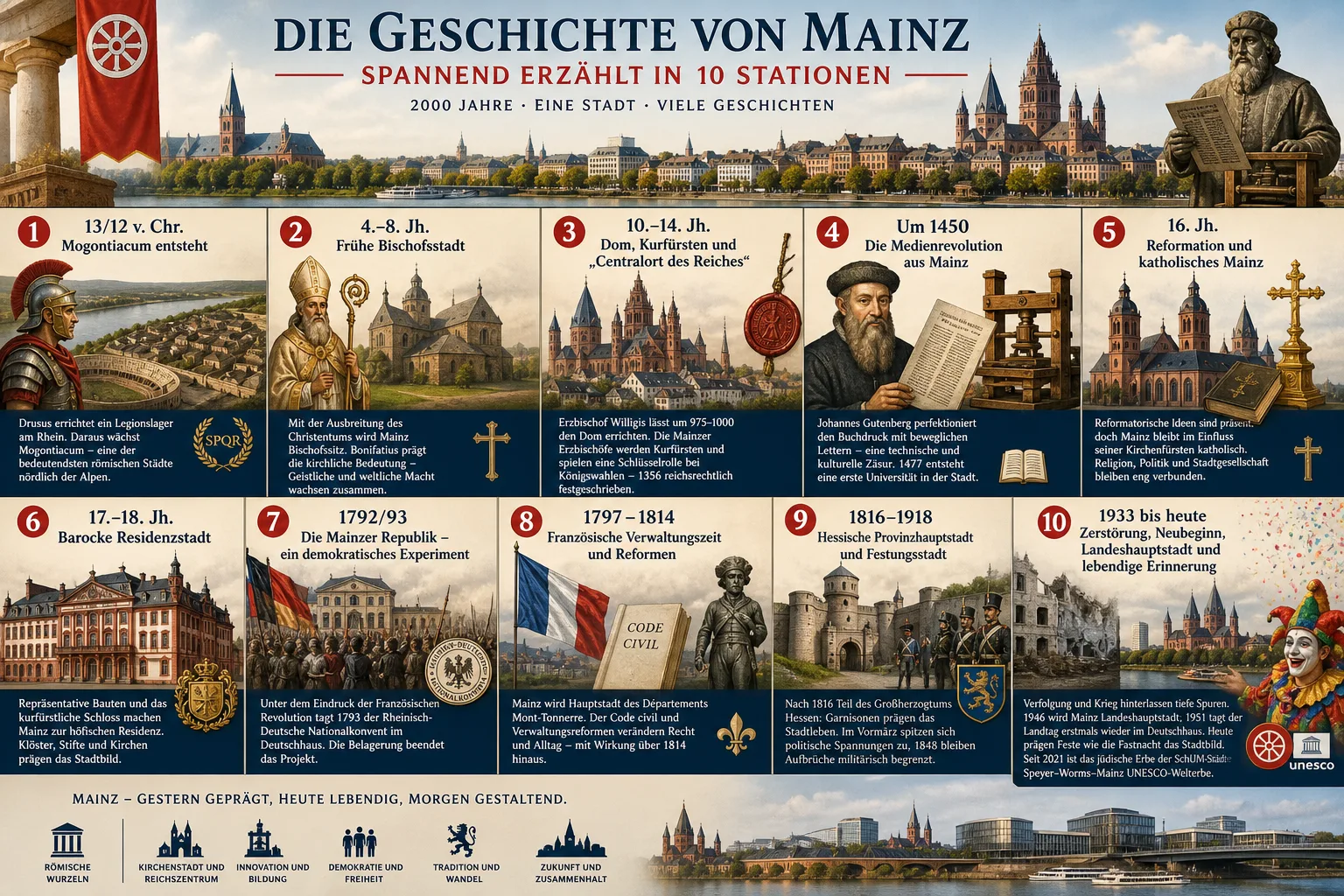
The History of Mainz – Excitingly Told in 10 Stations (Preview of an Upcoming Thematic Series)
This page announces a future thematic series that will make the city history of Mainz come alive in 10 stations as walks, lectures, or combined formats. Instead of a historical essay, you will find here a program and route overview: What will be covered when, which places are in focus, how can you prepare, and how do you behave respectfully at sensitive memorial sites.
Format & Procedure
What to Expect
- 10 compact stations with a clear common thread (from antiquity to the political present as a learning path).
- Local reference: Each unit is linked to a specific place or neighborhood.
- Source and object perspective: Where possible, image sources, maps, museum objects, or architectural features are integrated into the presentation.
- Reflection: A fixed component is the question of how remembrance culture is shaped today (including respectful behavior at memorial sites).
Who is the series intended for?
For people who want to (re)discover Mainz: locals, students, visitors, groups, and all those interested in city history, media history, architecture, and democratic culture. No prior knowledge is required.
The 10 Stations (Theme and Place Focus)
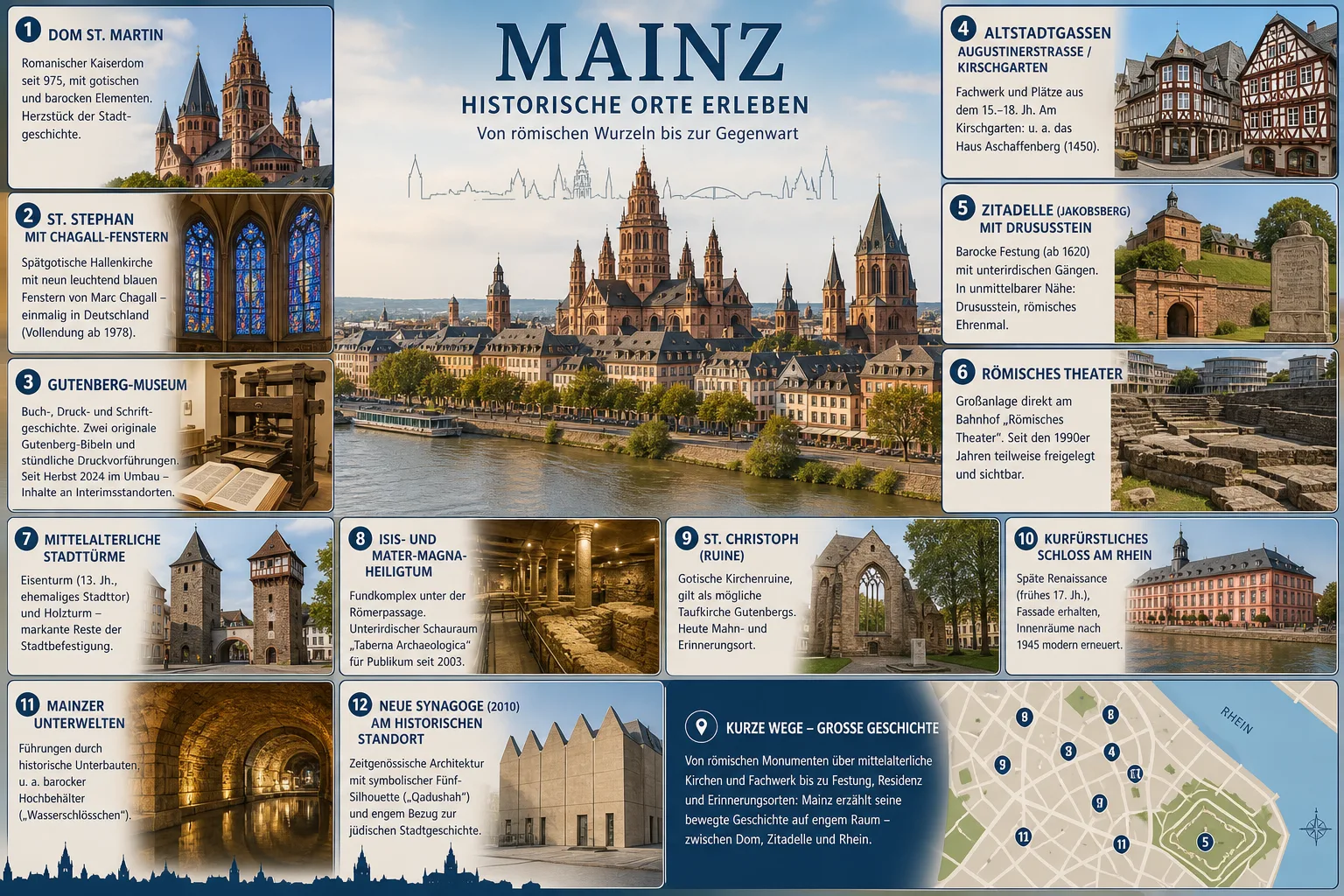
1) Antiquity on the Rhine: Roman Traces in the Cityscape
The focus of this unit is the archaeological perspective: How do you read ancient structures in today's city layout, and which places are suitable for an illustrative introduction? A tour is planned with a view of selected excavation and presentation sites in the city area.
2) Early Church & Urban Development: Sacred Spaces as Orientation
This station looks at the role of religious sites for urban space, education, and social order. The focus is on how church institutions could shape everyday life and urban structure over long periods and how this can be recognized in today's old town architecture.
3) Cathedral Area & Power Architecture: Understanding Political Centrality
A unit is planned on the symbolic language of large buildings: How does architecture communicate power, stability, and ambition? The cathedral area is particularly suitable for discussing city and power spaces (outdoor space, square edges, sightlines, construction phases).
4) Media Change: Printing, Public Sphere, and Knowledge Spaces
This station is dedicated to the topic of media and educational history with a Mainz connection. The content is about how the public sphere can change through new reproduction techniques, workshops, publishing and learning locations—and how museums and collections convey such processes today.
5) Baroque & Representation: City as Stage
Here, the focus is on how urban identity is expressed in residential, administrative, and church buildings. Observation tasks in the urban space are planned (facades, axes, squares), which can also be quickly applied by non-experts.
6) Democratic Learning on Site: Debate, Parliament, Public Sphere
This station is designed as a democracy and institutions perspective: How do parliamentary spaces work, what rituals and rules structure debates, and how can political history and current politics be meaningfully distinguished without mixing the two?
7) Administration & Law in Transition: Understanding Modern Structures
A unit is planned on how state order is reflected in administrative practices and legal culture. The aim is not legal advice, but a comprehensible overview of how "the state in everyday life" (registers, responsibilities, procedures) can be explained historically.
8) Military, Infrastructure, Growth: City Limits and Traffic Spaces
This station deals with the interaction of security logic, urban planning, and mobility. A focus can be the readability of former fortification and infrastructure lines in today's street and green system.
9) Remembrance Culture & Responsibility: Learning at Memorial Sites
This unit is deliberately planned to be calm and reflective. The focus is on how cities deal with loss, exclusion, and the history of violence and which forms of public remembrance (memorials, stumbling stones, exhibitions) are suitable for respectful, objective engagement.
10) Contemporary City: Festivals, Culture, and the Question "How Do We Tell Mainz?"
To conclude, the series brings together observations from all stations: Which narratives dominate city marketing, museums, and everyday life? How do festival culture, political satire, and historical education differ—and how can they be productively combined without oversimplifying history?
Practical Preparation
- Weather & Routes: Plan for comfortable shoes and weatherproof clothing; the route will likely lead through inner city areas with cobblestones and curbs.
- Notes: If you like, bring a small notebook: architectural details, street names, and sightlines can be better recorded.
- Museums/Interiors: If a unit includes indoor visits, the current house rules apply (bags, photography, group tours).
- Respect at Memorial Sites: Speak quietly, no staged photos, no disturbances of commemorative acts.
Accessibility & Safety
For the most inclusive participation possible, it is recommended to pay attention in advance to route length, inclines, cobblestone surfaces, and possible stairs at indoor stations. If an organizer offers accessible alternative routes, this will be indicated in the respective event announcement.
Safety note: For tours in street areas, it is generally required to use sidewalks, cross together, and avoid gatherings at bottlenecks.
Notes on Sensitive Places & Remembrance Culture
Some stations of the series are designed to address the handling of difficult chapters in city history. The following applies: Affected perspectives are taken seriously, language remains objective, and a clear distinction is made between documented information, interpretation, and personal reflection.
- Photography: At memorials and remembrance sites, only photograph sparingly and respectfully—or consciously refrain from doing so.
- Conversation culture: Controversy is possible, denigration is not. The series relies on questioning learning instead of quick judgments.
- Classification: Where institutions (museums, archives, parliaments) provide material, their context is explained (purpose, selection, perspective).
Sources & Further Links
The series is thematically based on publicly accessible information offerings from museums, monument preservation, parliament, and cultural heritage institutions. For preparation, the following are particularly suitable:
- Gutenberg Museum Mainz — Information on collections, education, and exhibitions (accessed 2026-09-16)
- State Parliament of Rhineland-Palatinate — Information on plenary hall, visitor offers, and political education (accessed 2026-09-16)
- City of Mainz (official portal) — City info, cultural offers, and event overviews (accessed 2026-09-16)
- UNESCO World Heritage Centre — Background on world heritage and protection principles (accessed 2026-09-16)
- General Directorate for Cultural Heritage Rhineland-Palatinate (GDKE) — Monument preservation, archaeology, and cultural heritage in Rhineland-Palatinate (accessed 2026-09-16)