Discover Riding Stables & Horse Farms around Mainz
Riding Stables & Horse Farms around Mainz: Planning, Selection and Appointments for the Coming Season
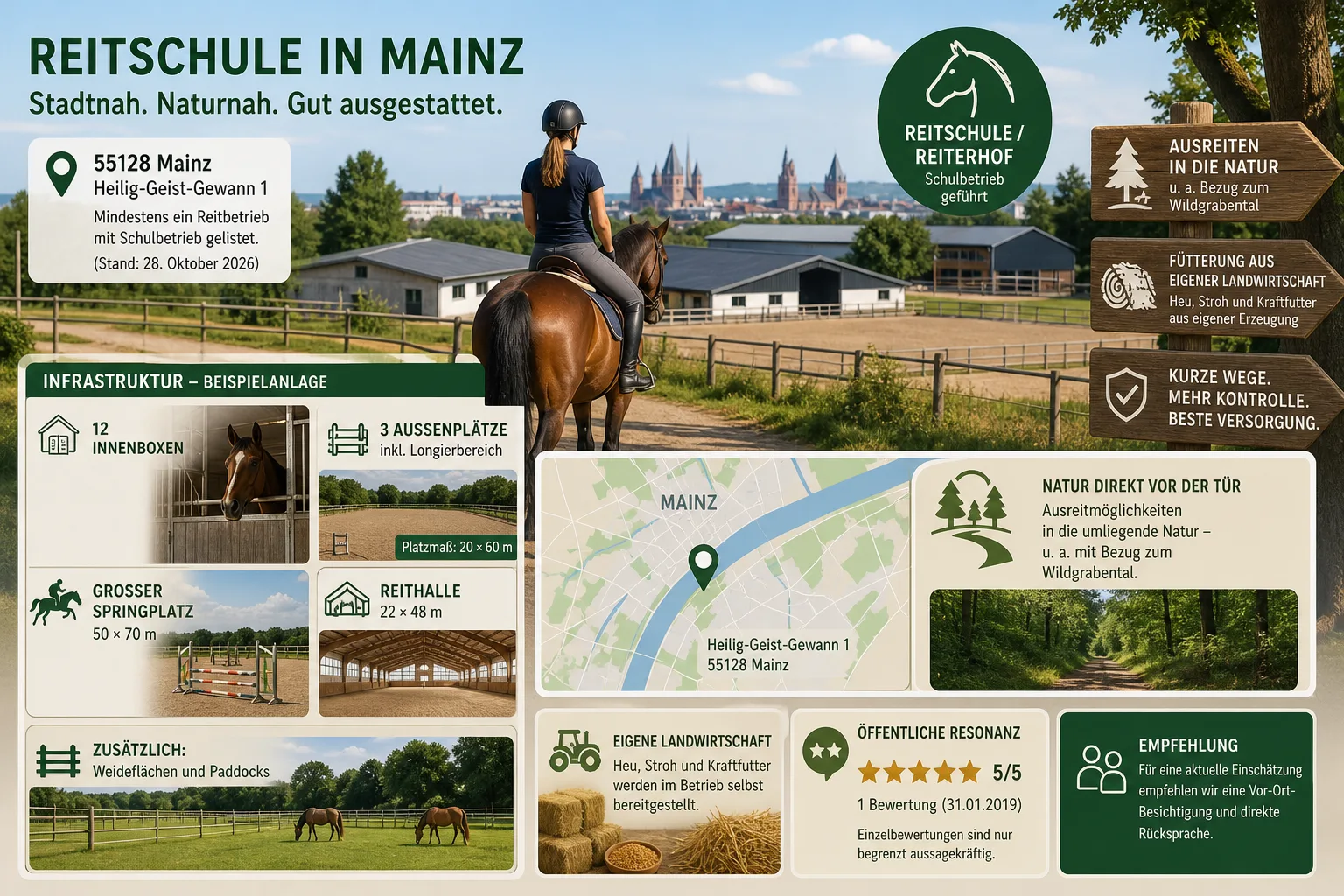
Anyone who wants to learn to ride, get back into riding, or board a horse around Mainz in the coming months will likely encounter a diverse stable landscape: riding schools with lessons, boarding stables with various forms of horse keeping, and farms offering trail rides in the surrounding area. This article helps you prepare for the upcoming season (e.g., winter training in the arena, spring start on outdoor arenas) and shows how you can approach future viewings, trial lessons, and contract questions in a structured way.
The focus is deliberately on what comes next: how to find future stable appointments, what to look out for during upcoming viewings, and which documents and questions you can have ready for the next steps.
Season Planning: What Will Be Important in the Coming Months
If you are choosing a riding stable around Mainz in the near future, your decision will largely depend on which season you start and how regularly you can be on site in the future. Typical planning points for the coming period:
- Winter/Bad Weather Phase: If you start in the coming weeks, a riding arena or a weatherproof lesson plan will be particularly relevant.
- Spring/Start of Grazing: If you are planning for spring, grazing concepts, grazing management, and maintenance of outdoor areas will likely come to the fore.
- Summer/Heat Periods: For summer, shade, drinking water management, and training times (morning/evening) will play a greater role in the future.
- Holiday Periods: If you are planning with children, course places and care offers during the upcoming school holidays will likely be booked up more quickly.
A sensible next step is usually to prioritize 2–4 stables for initial contact and to arrange trial lessons or viewing appointments soon.
Types of Operations in the Mainz Area: Riding School, Boarding Stable, Horse Farm
In the next season, you will typically encounter three basic models in the Mainz area. Your choice will depend on which goal you are pursuing:
Riding School (Lesson Operation)
- Suitable if you want to regularly take riding lessons (individual/group) in the future.
- The key question will be how lessons are organized: fixed course series, flexible booking, waiting lists, substitutes.
- For beginners, a well-structured safety and learning concept (helmet requirement, mounting aids, clear rules) will be particularly relevant in the future.
Boarding Stable (Boarding Your Own Horse)
- Suitable if you want to board your own horse/companion animal in the future.
- Key factors will be the keeping system, turnout, feeding, and regulations regarding illness, vet/farrier, emergencies.
- You should expect that popular stables will increasingly work with waiting lists; early inquiries will give you planning security.
Horse Farm with Trail Rides/Experience Offers
- Suitable if you are looking for trail rides, guided rides, or horse-related activities in the coming months.
- Here, it will be especially important that group sizes, route selection, and safety briefings match the experience level.
Stable Viewing & Trial Riding: Procedure and Checklist
For the next viewings, it will be worthwhile to come with a clear procedure. This way, farms can be fairly compared and important details won't get lost in the impression on site.
Recommended Procedure for Your Next Appointment
- Short Preliminary Talk: Purpose (lessons/boarding/re-entry), time frame, experience, possibly health topics (e.g., allergies) openly discuss.
- Tour: Stable aisle, tack room, grooming areas, riding arenas, route guidance (safety), turnout areas.
- Insight into Routines: Feeding times, turnout management, rest periods, rules for riding operations.
- Trial Riding/Trial Lesson: Suitable horse, clear task, short debriefing.
- Transparency Check: Written information on costs, services, rules, liability, and notice periods.
Checklist: Questions You Should Ask at the Next Viewing
- Safety: What rules will apply in the future in the stable aisle, arena, and on outdoor arenas (helmet, safety vests, dogs, children)?
- Riding Arenas: Which areas will be available in the coming season and when (arena, outdoor arena, lunging circle/lunging area, jumping opportunities)?
- Turnout: How will paddock/grazing be organized in the future (times, groups, weather limits, mud management)?
- Feeding: How is hay provided (quantities, frequency, nets/hay racks), what are the rules for concentrates, how are special needs handled?
- Animal Welfare Management: How will injuries, lameness, suspected colic, or quarantine be handled in the future?
- Communication: How are changes (e.g., arena closures, course cancellations) announced?
Keeping & Feeding: What You Should Specifically Pay Attention to in the Future
In the coming months, the topic of horse-appropriate keeping will become even more visible in many stables: turnout organization, roughage management, and stable climate shape everyday life and health. For your upcoming selection, these points will be particularly meaningful:
Roughage (Hay) and Stable Climate
- Hay Quality: In the future, you should pay attention to smell (pleasant, not musty), dust development, and storage.
- Feeding Rhythm: Ask how many hay feedings are usual per day and how breaks are bridged (e.g., hay nets).
- Ventilation: A well-ventilated stable will be especially important in the coming arena season when horses spend more time indoors.
Bedding (e.g., Straw) and Hygiene
- Cleanliness: At future appointments, pay attention to whether lying areas remain dry and whether manure management is transparently organized.
- Individual Solutions: Clarify in advance whether alternatives are possible in the future for respiratory problems or allergies (only if the operation actually offers them).
Turnout: Paddock, Pasture, and Social Contacts
For the coming year, turnout management will often be the main difference between stables. A good concept is recognizable by clear rules for group composition, fence control, weather limits, and acclimatization.
Riding Lessons & Safety: Requirements for Upcoming Courses
If you book lessons soon, you will benefit most if lesson objectives, safety standards, and training paths are transparent. For the next steps, you can orient yourself on the following quality features:
- Didactics: For beginners, a step-by-step structure (balance, aids, arena rules) will significantly increase learning success in the coming weeks.
- Horse Selection: A suitable school horse will be more important in the future than "rapid progress"; ask about the criteria for allocation.
- Rules in the Arena: For the coming arena season, right-of-way rules, arena figures, and emergency procedures should be explained in advance.
- Equipment: For the start in the next appointments, plan for a suitable riding helmet; clarify in advance whether rental helmets are available and what standard the stable requires.
If children are to participate in the future, a short, repeatable safety procedure (mounting, stopping, distance, behavior when startled) will be a decisive quality feature.
Contracts, Costs and Transparency: How to Avoid Surprises Later
Before you make a commitment in the next few weeks, services and obligations should be clearly set out in writing. This applies to both lesson packages and boarding contracts.
For Riding Lessons (Upcoming Bookings)
- Cancellation Rules: What deadlines will apply in the future, what happens in case of illness or weather?
- Scope of Services: Duration of the unit, group size, arena use, holiday regulations.
- Safety Rules: Helmet requirement, clothing, handling of photos/videos.
For Horse Boarding (Upcoming Boarding Decisions)
- Included Services: Feeding (roughage/concentrates), mucking out, turnout service, blanket service, additional services.
- Emergency Regulation: Who will be informed in the future and when, who is allowed to call the vet/farrier?
- Notice Periods & Price Adjustments: How are changes announced and from when do they apply?
For a good gut feeling in your next decision, it is often not the lowest price that is decisive, but the combination of clear procedures, reliable communication, and transparent animal welfare practices.