Civic Participation in Mainz: Guidelines, Advisory Board, Procedures
Civic Participation & Urban Development in Mainz: How You Can Effectively Get Involved Starting 2026
A Future Guide: Which participation pathways you can expect in the coming months and years for projects on mobility, public spaces, and neighborhoods – explained clearly and practically.
Why Civic Participation Is Worthwhile for Upcoming Decisions in Mainz
In the coming years, many cities – including Mainz – will face decisions that will shape everyday life in the long term: traffic management, public transport expansion, climate-adapted street spaces, new quality of stay in public squares, or the further development of entire neighborhoods. If you want to participate from 2026 onwards, it’s less about “just giving an opinion somewhere,” and more about influencing at the right time and through appropriate procedures.
This article explains which steps you can typically expect in future projects in Mainz, how to prepare effectively, and how to recognize whether a process is merely informative or allows for real co-creation.
What You Can Use as Orientation in the Future: "Guidelines" and Quality Standards for Participation
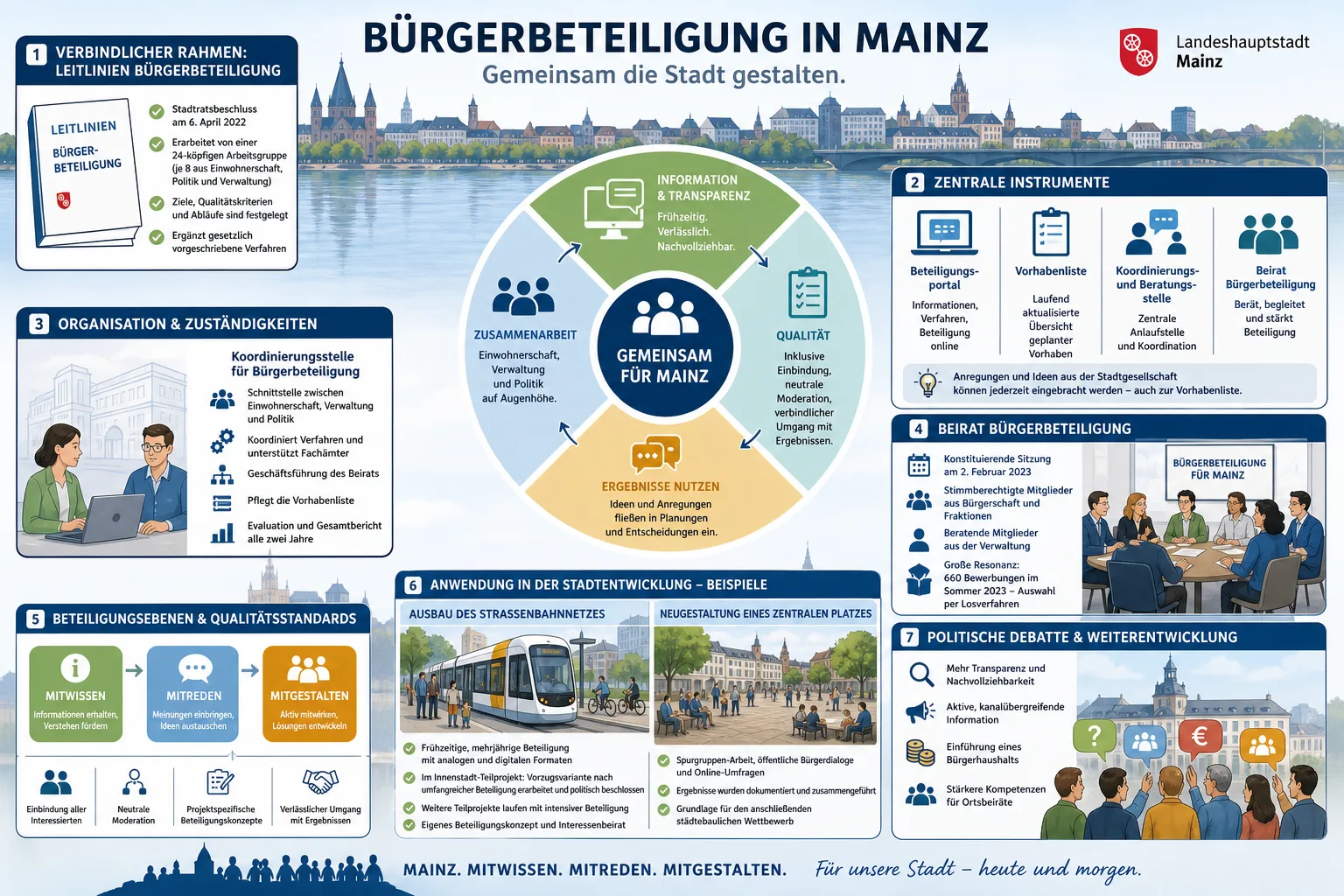
In future participation processes in Mainz, you will often encounter guidelines for civic participation and associated quality criteria. These standards are mainly intended to ensure that participation starts in early project phases and that results are handled transparently.
How to Recognize Quality in Future Procedures
- Early Start: Information and participation begin before options become “locked in.”
- Understandable Materials: Maps, goals, constraints (e.g., law, safety, accessibility), timelines, and decision paths are explained so that non-experts can participate meaningfully.
- Transparent Feedback: You will later receive a reasoned response as to which suggestions are adopted, which are adjusted, and why some cannot be implemented.
- Fair Moderation: In workshops and dialogue formats, moderation ensures that different perspectives are given space.
- Documentation & Evaluation: Results are documented; the impact of the process is evaluated so that later processes can be improved.
For you as a participant, this means: The clearer a process fulfills these points, the greater the chance that your contribution will be included in the professional assessment and political decision.
Which Tools You Will Typically Use in Upcoming Mainz Projects
1) Project List: Early Recognition of What’s Coming Up Next
For future urban development projects, you will usually first learn about which measures are being prepared via a project list or comparable project overviews. There you will typically see:
- What the project is about (goal, location, reason),
- which phase it is in (idea, preliminary planning, draft, implementation preparation),
- whether and when participation is planned,
- how you can register, get information, or provide feedback.
Practical Tip for 2026+: If you want to have an influence, it’s worth taking a look as soon as a project is still in an early phase. In later phases, room for maneuver is often smaller because legal requirements (e.g., land-use planning) or technical conditions become more significant.
2) Participation Portal: Digital Participation for Upcoming Surveys, Dialogues, and Public Displays
For many future procedures, you will be able to use digital participation offerings – such as online surveys, map comments, idea submissions, or event announcements. Digital formats make it easier for you to participate if you have little time or cannot attend every event in person.
To ensure that digital participation remains effective in the coming years, two rules help:
- Specific Rather Than General: Formulate comments based on location and situation (e.g., “Crossing at X is unclear because…”).
- Reason & Goal: Add what goal you are pursuing (safety, quality of stay, accessibility, delivery traffic, climate shade).
3) Coordination: How to Find Contact Points and Responsibilities in the Future
For more complex participation, you will often deal with a coordinating office or project office in the future. They typically bundle information, organize processes (appointments, moderation, documentation), and help structure procedures transparently between administration, politics, and the public.
If you have questions about an ongoing process from 2026 onwards, these are the most important “orientation questions” you can ask a contact point in practice:
- What decision is pending at the end – and who decides when?
- Which points are open (design options) and which are fixed (e.g., standards, safety, budget)?
- How are submissions handled (criteria, evaluation, feedback)?
- What are the next dates and participation windows planned?
4) Advisory Board/Boards: Resonance Spaces That Can Accompany Future Procedures
In Mainz, advisory boards or accompanying committees can play an important role in future processes: They can discuss procedures, pay attention to fairness and transparency, and make recommendations for further development. For you, this means: If you want to know how participation is to be “systematically” improved, it’s worth following the public information of such committees and keeping an eye on their meeting dates.
The Three Levels You Should Distinguish in Upcoming Participation
For future urban development projects, it is crucial to know which participation promise actually applies. Procedures can often (depending on the project phase) be classified into three levels:
Being Informed: When Information Is the Main Focus in the Coming Weeks
In early or very formal phases, you will sometimes mainly receive information: goals, framework conditions, options, timeline. This level is valuable if it starts early enough and is presented in an understandable way – because it enables you to prepare specifically for later phases of discussion or co-creation.
Having a Say: When Feedback Is Planned and Evaluated
At this level, opinions, local comments, and conflicts are actively sought – for example, through moderated dialogues, workshops, consultation hours, or online participation. For upcoming processes, the clearer the city communicates which questions are open, the more effectively you can contribute.
Co-Creating: When You Will Work on Options and Solutions in the Future
Co-creation means that participants actively work on solution proposals, for example in planning workshops or co-creative formats. In the coming years, this level is particularly useful for questions such as: allocation of street space, design of public squares, green and shade concepts, safe school routes, or usage concepts for public spaces.
To ensure that co-creation does not become frustrating, one point is central for upcoming procedures: Binding Feedback. You should later be able to understand how results were incorporated into the decision-making process.
How to Prepare for Upcoming Projects (Mobility, Public Spaces, Neighborhoods)
Mobility & Public Transport: What to Consider in Future Network and Route Debates
When new routes, stop locations, or redesigns of junctions are discussed in the coming years, goals often clash: speed vs. quality of stay, safety vs. flow, delivery traffic vs. cycling and walking, accessibility vs. lack of space. You can contribute most effectively if you:
- Identify conflicts specifically (location, time of day, user groups),
- Link suggestions to goals (e.g., “safer” or “more accessible”),
- Also address side effects (e.g., detour traffic, noise, crossings),
- Ask questions about the data basis (traffic counts, safety analyses, accessibility checks).
Public Spaces: How to Constructively Shape Future Design Processes
For future public space and open space projects, contributions that consider usage from different perspectives are helpful: families, older people, people with mobility impairments, visitors, residents, gastronomy, culture. Particularly useful are comments on:
- Shade, heat, and water management (climate-adapted design),
- Seating and quality of stay (also in the evenings, also in winter),
- Sense of security (lighting, sightlines),
- Path connections and crossings,
- Usage conflicts (events, quiet, passage, litter, delivery logistics).
Neighborhoods: What Is Often Decided “Under the Radar” in the Coming Years
Many decisions that you will later feel in everyday life do not arise from a single major resolution, but from a series of smaller steps: traffic calming, parking management, new cycling connections, redesign of stop environments, green access, areas to stay. For upcoming neighborhood processes, it may be worthwhile to clarify early on:
- What goals does the neighborhood pursue (e.g., safe routes, less through traffic, more green)?
- Which target groups are particularly affected (schools, daycare centers, care, businesses)?
- Which measurable indicators should improve (e.g., accident numbers, accessibility, heat stress, length of stay)?
Outlook 2026–2028: Which Developments in Participation Are Realistic
For the next few years, three trends are likely in municipal participation processes – including in Mainz:
- More Transparency About Decision-Making Paths: Participation becomes more comprehensible when it is clear when administrative proposals are developed, when politics decides, and how feedback is documented.
- More Hybrid Formats: On-site events are more often combined with digital components (livestream, online maps, digital minutes) so that more people can participate.
- Stronger Link to Climate Adaptation & Mobility Transition: As time pressure and goal conflicts increase, clear participation questions (What is negotiable?) become more important than as many open discussion fields as possible.
If you want to get involved strategically from now on, a simple plan helps: Observe the project overviews, get involved in the information phase, and put your greatest effort into the moment when options are still shapeable.